Switching Foods for a Shih Tzu With a Sensitive Stomach: How to Do It Slowly
General nutrition information compiled from product labels and published sources, not veterinary advice. Your veterinarian is the right person to choose a diet for your dog, especially one with a health condition.
A new bag of food can upset a small dog's stomach even when the recipe is a good one. A sudden change is often the real problem. This guide walks through a slow switch, one small step at a time.
It also explains how to read labels when you are choosing the best dog food for shih tzu with sensitive stomach signs, such as loose stools or picky eating. A veterinarian decides what is right for an individual dog, and that matters most if your Shih Tzu has ongoing symptoms.
Why a slow switch matters for a Shih Tzu
WebMD lists adult Shih Tzu weight at about 9 to 16 pounds. That is a small body with a small stomach, so a big change in one meal is a large change for the dog.
WebMD also names obesity and skin and ear allergies among the breed's diet-related concerns. It does not say what causes the allergies, which can be food or environmental. That is one more reason to change only one thing at a time, so you can tell what your dog is reacting to.
A slow switch will not fix a food that does not suit your dog. It simply gives you a cleaner picture of how your dog handles the new food.
What you need before you start
- The new food, in a bag or can with the full label.
- Enough of the current food to last through the whole switch.
- A measuring cup, or a kitchen scale for grams. Scoops and bowls vary a lot in size.
- A notebook or phone note to log meals, stools, and appetite.
- Your dog's current weight, and the age and activity level you plan to feed by.
- Your veterinarian's phone number, in case symptoms get worse.
Step 1: Read the new label before you buy more than one bag
Start with the nutritional adequacy statement. It should say the food meets AAFCO Dog Food Nutrient Profiles for your dog's life stage, either through a formulation statement or through feeding tests.
Next, check the first few ingredients and the guaranteed analysis. Marketing words on the front of the bag are not a substitute for this panel.
For a Shih Tzu puppy, look at the large-breed wording. Whole Dog Journal explains that foods for growth or all life stages carry one of two statements: one says the food includes growth of large-size dogs (70 pounds or more as an adult), and the other says it excepts it. Small-breed puppies can eat foods with either statement.
Step 2: Compare calories, not just cups
Foods differ in how many calories fit in a cup. If you swap cup for cup, your dog may eat more or less energy than before. The calorie figures below come from the brands' own product pages.
| Food (dry) | Calories per cup, per the brand |
|---|---|
| Royal Canin Breed Health Nutrition Shih Tzu Adult | 355 kcal ME, calculated |
| Royal Canin Breed Health Nutrition Shih Tzu Puppy | 354 kcal ME, calculated |
| Hill's Science Diet Adult Small Bites Chicken & Barley | 365 kcal |
| VICTOR Hi-Pro Plus Small Breed Adult | 360 kcal |
| Hill's Science Diet Puppy Small & Mini Chicken & Brown Rice | 418 kcal |
We compared label data only. We did not run feeding trials or taste tests, so this table says nothing about how any food sits with a given dog's stomach.
Step 3: Work out the daily amount from the label
Use the feeding guide on the new food as a starting point, not a rule. Guides are set by weight, age, and activity level, and your dog may need more or less.
A few examples of how brands present this:
- Royal Canin's Shih Tzu Adult page gives a table by weight and activity level. Its example is a low-activity 8.8 pound (4 kg) dog at 3/4 cup (66 g) per day.
- Royal Canin's Shih Tzu Puppy page uses puppy age (2 to 9 months) and expected adult weight.
- VICTOR's Hi-Pro Plus Small Breed Adult page lists 1/2 cup daily for a 5 pound dog and 1 cup for a 10 pound dog, using a standard 8 ounce measuring cup.
- Hill's Pet tells owners to adjust amounts as necessary to maintain optimal weight, and to ask a veterinarian if unsure.
For a full picture across ages, see our Shih Tzu feeding chart by age and weight. If your dog has a health condition, confirm amounts with your veterinarian before you set them.
Step 4: Mix the foods in small steps
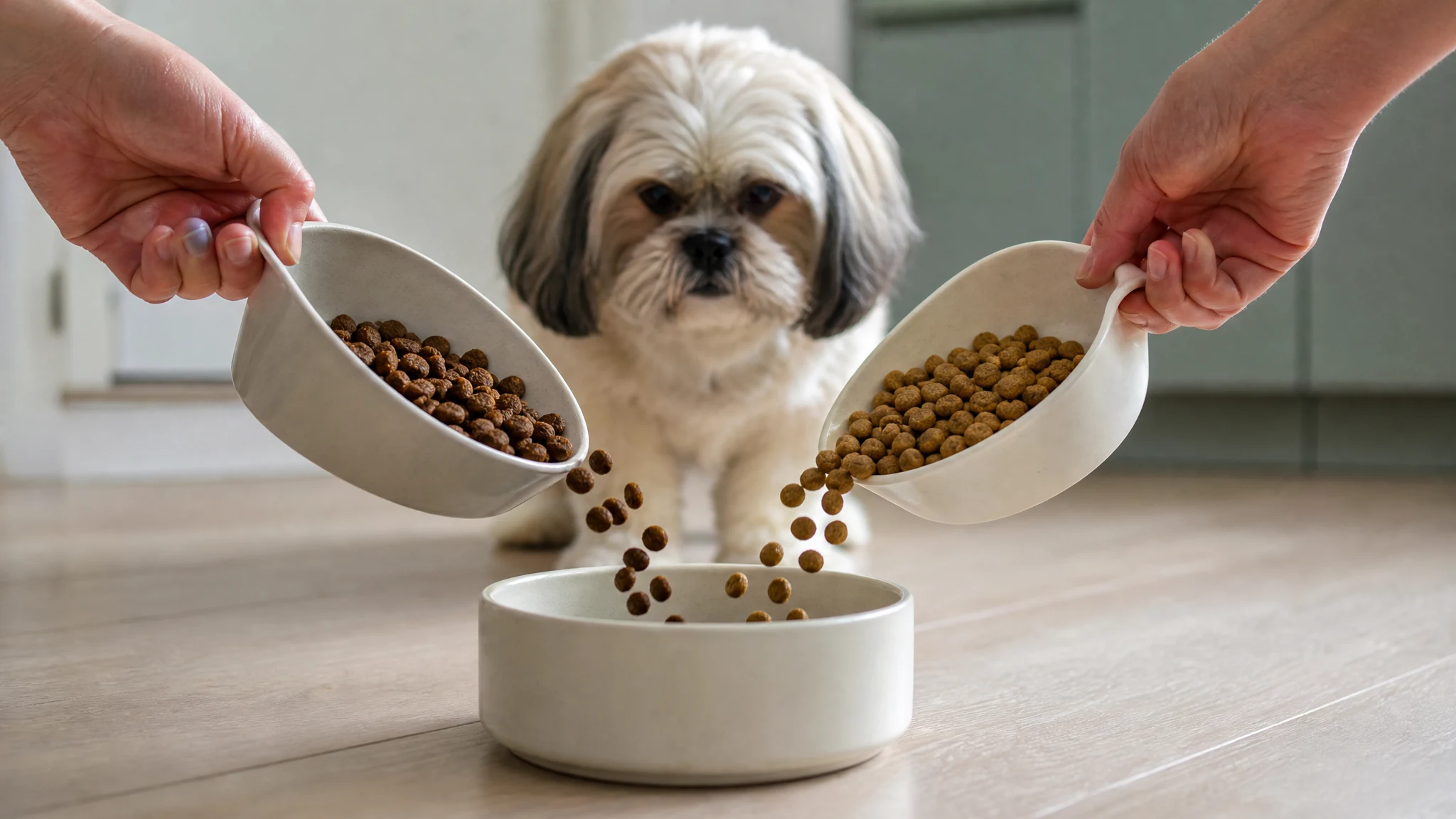
A common approach is a gradual blend over about a week to ten days. Many owners stretch it longer for a sensitive dog. There is no single schedule that suits every dog, so treat the one below as a template.
- Days 1 to 3: about one quarter new food and three quarters old food.
- Days 4 to 6: about half new and half old.
- Days 7 to 9: about three quarters new and one quarter old.
- Day 10: all new food, if stools and appetite have stayed steady.
Keep the total daily amount the same as your dog's current calorie intake while you mix. Only adjust once the switch is finished and you can judge body condition.
Split the day's food into the same number of meals you already use. Do not add treats, new chews, or table scraps during the switch.
If you are moving between forms, such as dry to fresh or wet, the same slow idea applies. Check the brand's own page for its feeding notes. Freshpet's small dog recipe page, for example, lists 1/2 to 1 cup per day for 5 to 10 pound dogs, in one or two meals.
Step 5: Watch and log for two weeks
Write down each day's stool quality, appetite, energy, itching, and any vomiting. Patterns show up more clearly on paper than in memory.
If stools soften a little, hold at the current mix for a few extra days before moving on. If symptoms are more than mild, or they last, go back to the old food and call your veterinarian.
Step 6: Check body condition after the switch
Because obesity is listed as a breed concern, look at your dog's shape every couple of weeks. You should be able to feel the ribs under a light covering. If you cannot, or if your dog looks thin, ask your veterinarian to help adjust the amount.
Tips that make the switch easier
- Change one thing at a time. Do not start a new treat, a new dental chew, and a new food in the same week.
- Keep mealtimes steady. Regular timing is easier on a small stomach.
- Mix the foods well so your dog cannot pick out only the old one.
- Keep fresh water out. Some dogs drink more when the food changes.
- Store the new food as the brand directs, and keep the old bag until the switch is done.
- Keep notes on the exact product name and life stage. Names can be close, such as a puppy and an adult version of the same line.
Common mistakes to avoid
- Switching all at once. This is the most common cause of a rough week.
- Swapping cup for cup without checking calories. The table above shows why that can shift intake.
- Judging too early. A single loose stool on day two does not tell you much. A trend over several days does.
- Feeding a puppy food to an adult, or the reverse, without a reason. Match the label's life stage to your dog.
- Assuming a grain-free or exotic recipe is gentler. The FDA has investigated a possible link between certain diets and canine dilated cardiomyopathy (DCM). Its latest update is dated December 23, 2022, and it cautions that report counts alone do not show a product caused illness. Ask your veterinarian before choosing that route.
- Treating a food as medicine. No over-the-counter food is a treatment for allergies or other conditions. Prescription diets are something only a veterinarian prescribes.
- Adding supplements on your own during the switch. If your veterinarian recommends one, follow their instructions for your dog.
What results to expect
Many dogs handle a gradual switch with firm, steady stools and normal appetite. Some may take longer to settle. A slow change may reduce the chance of stomach upset, but it cannot promise a particular outcome, and every dog responds differently.
If your dog is itchy, has ear trouble, or has recurring stomach problems, a new food may not be the answer. Those signs can have several causes, and WebMD does not tie the breed's allergies to one trigger. A veterinarian can help sort out the cause.
When to call your veterinarian
- Repeated vomiting or diarrhea.
- Refusal to eat for more than a day.
- Lethargy, or signs of pain.
- Noisy or labored breathing. Shih Tzus can have short-nosed airway problems, so do not wait on this one.
- Any symptom that worries you.
Where to find the label details
For current ingredients, guaranteed analysis, and feeding guides, go to each brand's own page. Labels and recipes change, so check the live page and the bag in your hands before you buy. Where a brand's page does not state a figure, such as kibble size, ask the brand directly.
Sources
- WebMD: What to Know About Shih Tzus
- Whole Dog Journal: In the Fine Print, Nutritional Adequacy Statements
- FDA Center for Veterinary Medicine: Investigation into diets and canine DCM
- Royal Canin: Breed Health Nutrition Shih Tzu Adult
- Royal Canin: Breed Health Nutrition Shih Tzu Puppy
- Hill's Pet: Science Diet Adult Small Bites
- Hill's Pet: Science Diet Puppy Small & Mini
- VICTOR Pet Food: Hi-Pro Plus Small Breed Adult
- Freshpet: Small Dog Bite Size Chicken Recipe