How Much to Feed a Shih Tzu: Feeding Chart by Age and Weight
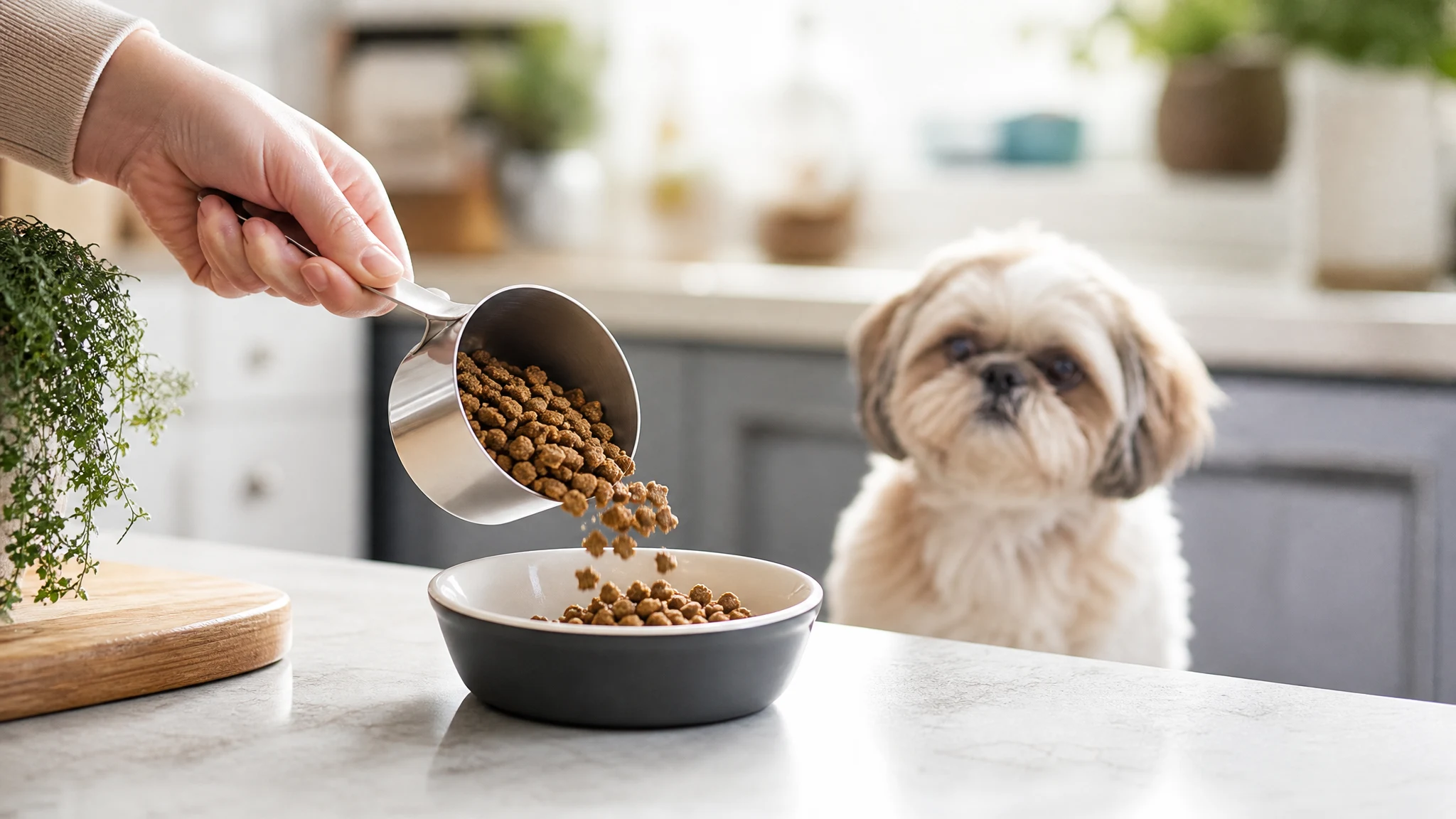
General nutrition information compiled from product labels and published sources, not veterinary advice. Your veterinarian is the right person to choose a diet for your dog, especially one with a health condition.
Most owners ask the same thing sooner or later: how much should a Shih Tzu eat each day? The honest answer is that no single number fits every dog. A Shih Tzu's daily amount depends on weight, age, activity, and the calories packed into the specific food in the bowl.
This guide shows you how to find a sensible starting amount from a food's own label, how to check whether it is working, and how to adjust. It also includes a Shih Tzu feeding chart built from label guides that brands publish. These are starting points. A veterinarian sets the amount for an individual dog.
What you need before you start
- The bag, can, or package of the food you actually feed, with the feeding guide on it.
- A standard dry measuring cup, or a kitchen scale that reads in grams.
- A scale that can weigh your dog. A bathroom scale works: weigh yourself, then weigh yourself holding the dog, and subtract.
- A notebook or phone note to record weight, amounts, and treats.
- Your veterinarian's contact details, since they make the final call.
What a Shih Tzu weighs, and why it matters
WebMD, a secondary source, gives an adult Shih Tzu weight of 9 to 16 pounds. That is a wide range for a small dog. A 9 pound dog and a 16 pound dog can need very different amounts, so the weight on your scale matters more than the breed average.
WebMD also lists obesity among the health concerns for the breed. That is one reason careful measuring is worth the effort. It does not mean any food prevents or treats a health problem. Diet is one piece of a larger picture, and your veterinarian decides what is right for your dog.
Step 1: Weigh your dog and write it down
Start with a real number. Guessing is how a 12 pound dog ends up fed like a 16 pound dog.
Weigh at the same time of day, ideally before a meal. Record the date and weight. Repeat every two to four weeks. A small dog's weight can shift by only a few ounces, and those ounces are a large share of the body.
Step 2: Read the calories on the label
Cups are not a standard unit of nutrition. One cup of one food can carry far more calories than a cup of another. Look for the calorie statement, usually written as kcal per cup, per can, or per kilogram.
The label examples below show how much the numbers differ:
- Royal Canin lists 355 kcal ME per cup (as fed, calculated) for its Breed Health Nutrition Shih Tzu Adult dry food.
- VICTOR lists 360 kcal per cup for its Hi-Pro Plus Small Breed Adult.
- Freshpet lists 267 kcal per cup (calculated ME) for its Small Dog Bite Size Chicken Recipe.
- Nom Nom lists 244 kcal per cup (calculated value) for its Chicken Cuisine.
So a cup of the fresh recipes is a lighter serving in calories than a cup of the dry foods. Swapping foods cup for cup can quietly change how much your dog eats. If you change foods, redo this step.
Step 3: Find the starting amount in the feeding guide
Every complete food has a feeding guide. Find your dog's current weight in it, then pick the line for the right life stage and activity level if the guide has them. Treat the result as a starting point, not a target.
Shih Tzu feeding chart from label guides
The table below uses the published feeding guides of specific foods for small dogs. Each row names the brand page it comes from. The calorie math is simple multiplication of the label's own numbers, shown for comparison only.
| Food and brand label used | Dog size in the label example | Label's daily amount | Label's calories |
|---|---|---|---|
| Royal Canin Breed Health Nutrition Shih Tzu Adult (dry) | 8.8 lb (4 kg), low activity | 3/4 cup (66 g) | 355 kcal per cup, so about 266 kcal for 3/4 cup |
| VICTOR Hi-Pro Plus Small Breed Adult (dry) | 5 lb | 1/2 cup | 360 kcal per cup, so about 180 kcal for 1/2 cup |
| VICTOR Hi-Pro Plus Small Breed Adult (dry) | 10 lb | 1 cup (standard 8 oz measuring cup) | 360 kcal per cup |
| Freshpet Small Dog Bite Size Chicken Recipe (fresh) | 5 to 10 lb | 1/2 to 1 cup, in one or two meals | 267 kcal per cup, so about 134 to 267 kcal |
| Nom Nom Chicken Cuisine (fresh) | 10 lb adult | 1 cup | 244 kcal per cup |
| Royal Canin Mature 8+ Loaf in Sauce (canned, small breeds up to 22 lb) | 4.4 lb (2 kg), low activity | 1 can (153 g) | 145 kcal per 153 g can |
Read the table carefully. The dogs in the label examples are not all the same size, and a Shih Tzu at 9 to 16 pounds will usually sit above some of these example weights. Do not scale the numbers up by guesswork. Open the brand's full table for your dog's weight.
Hill's Science Diet and the other brands in this comparison tell owners to adjust amounts to maintain optimal weight and to ask a veterinarian if unsure. Some brand pages, such as Royal Canin's Small Puppy page, show amounts only in an image or a calculator. Use those tools on the brand's own site.
Feeding a Shih Tzu puppy by age
Puppies need a different guide than adults. The Royal Canin Breed Health Nutrition Shih Tzu Puppy page has a daily table by puppy age (2 to 9 months) and expected adult weight (8.8, 11, or 15 lb). Royal Canin describes that food as for purebred Shih Tzus from 8 weeks to 10 months old. Check the Royal Canin Shih Tzu Puppy page for the exact amounts, since they change month by month.
Puppy foods are labeled by an AAFCO statement. According to Whole Dog Journal, a secondary source, growth and all-life-stages foods carry one of two statements about large-size dogs (70 pounds or more as an adult). Whole Dog Journal says small-breed puppies can eat foods with either statement. A Shih Tzu is far below that adult weight, so either wording is not a concern on its own.
Ask your veterinarian how many meals per day suit your puppy, and when to move to an adult food. Royal Canin calls a Shih Tzu an adult at 10 months for its own product line, but other sources and brands vary, so confirm the timing with your veterinarian.
Feeding a senior Shih Tzu
WebMD gives an average life expectancy of 10 to 18 years. Older dogs often move less and may need fewer calories, but some need more. Royal Canin's Mature 8+ canned food, for example, is made for small breeds over 8 years old. Your veterinarian can tell you whether your dog's needs have changed.
Step 4: Check body condition, not just the scale
Weight alone does not tell you whether a Shih Tzu is lean or carrying extra fat. That is especially true under a full coat. Body condition scoring is a hands-on check that veterinarians use. They often use a numbered scale for it. Ask your veterinarian to show you how, then repeat it at home.
A general approach looks like this:
- Feel the ribs. Run your fingers over the side of the chest. In a healthy-looking dog you can usually feel the ribs under a thin layer of padding without pressing hard. If you must dig to find them, ask your veterinarian whether your dog is carrying extra weight.
- Look from above. Stand over your dog. A waist, a slight narrowing behind the ribs, is generally what to look for. A straight or bulging outline can mean extra weight.
- Look from the side. The belly should tuck up slightly behind the ribs rather than hang level or sag.
- Part the coat. Hair hides the body. Always feel through the coat rather than judging by how fluffy your dog looks.
Write down what you find along with the weight. A condition that changes slowly across several checks tells you more than any single day.
Step 5: Adjust for activity, then change by small steps
Label guides often split by activity level. The Royal Canin adult and Mature 8+ examples above are both for low-activity dogs. A Shih Tzu that takes long daily walks may need more than a mostly indoor lap dog, and a dog that is less active than usual may need less.
If your dog is gaining weight or feels padded over the ribs, talk to your veterinarian before cutting. If your dog seems too lean, talk to your veterinarian before increasing. Both can have causes unrelated to food. When your veterinarian agrees a change is right, make it in small steps and recheck in a few weeks.
Count treats. Treats, chews, and table scraps add calories that the feeding guide does not account for. Most brands expect the amount on the label to be the whole diet, so treats are often best taken out of the daily portion. Ask your veterinarian how much room to leave.
Step 6: Measure every meal the same way
A scoop is not a measure. A heaped cup can hold much more than a level one, and the difference matters when the daily total is under a cup. Level the cup, or weigh the food in grams if the label gives grams, as Royal Canin does for its Shih Tzu Adult example.
If you feed more than one meal a day, divide the daily total by the number of meals. Do not add a second full serving. The label amount is for the whole day.
Common mistakes to avoid
- Feeding by the bowl rather than the measure. Topping up a bowl without measuring makes the real intake unknowable.
- Using the wrong life stage. A puppy food fed to an adult, or the reverse, changes calories and nutrients. Match the AAFCO statement and life stage to your dog.
- Copying another dog's amount. A neighbor's 16 pound Shih Tzu is not your 10 pound dog.
- Forgetting to recalculate after a food change. As the calorie list above shows, a cup is not the same from food to food.
- Judging by coat. The coat can hide both weight gain and weight loss.
- Treating the chart as a rule. It is a place to begin. Your dog's body tells you what comes next.
- Adding supplements on your own. Ask your veterinarian first. This article does not cover supplement amounts.
What to expect
If the starting amount suits your dog, you may notice steady energy, a stable weight across weekly weigh-ins, and ribs you can feel under a light cover. Results vary from dog to dog, and some dogs take several weeks to settle on an amount.
Weight that keeps climbing or dropping, a change in appetite, or signs of discomfort after meals are reasons to call your veterinarian. They are better placed than any chart to judge whether diet, a health issue, or something else is behind it. Skin or ear trouble, which WebMD lists as a concern in the breed, can have food or environmental triggers that the source does not separate, so those also call for a veterinary visit rather than a guess about the bowl.
How we compared these label guides
We compared published label data: feeding guides, calorie statements, and AAFCO statements from each brand's own page. We did not run feeding trials or taste tests, and we did not feed any of these products to dogs. The table shows what the labels say. It does not show how any food performs for your dog.
To see how the foods stack up on ingredients, protein, fat, and calories, read our comparison of dog foods for Shih Tzus by label data.
The short version
To work out how much to feed a Shih Tzu, weigh the dog, read the calories on the label, find the starting amount in that food's own guide, and check body condition by hand. Then adjust slowly with your veterinarian. The question of how much a Shih Tzu should eat has no universal answer, and a careful routine gets you closer than any single chart.
Sources
- WebMD: What to Know About Shih Tzus
- Whole Dog Journal: In the Fine Print, Nutritional Adequacy Statements
- Royal Canin: Breed Health Nutrition Shih Tzu Adult
- Royal Canin: Breed Health Nutrition Shih Tzu Puppy
- Royal Canin: Mature 8+ Loaf in Sauce
- VICTOR: Hi-Pro Plus Small Breed Adult
- Freshpet: Small Dog Bite Size Chicken Recipe
- Nom Nom: Chicken Cuisine