Wet vs Dry vs Fresh Food for Shih Tzus
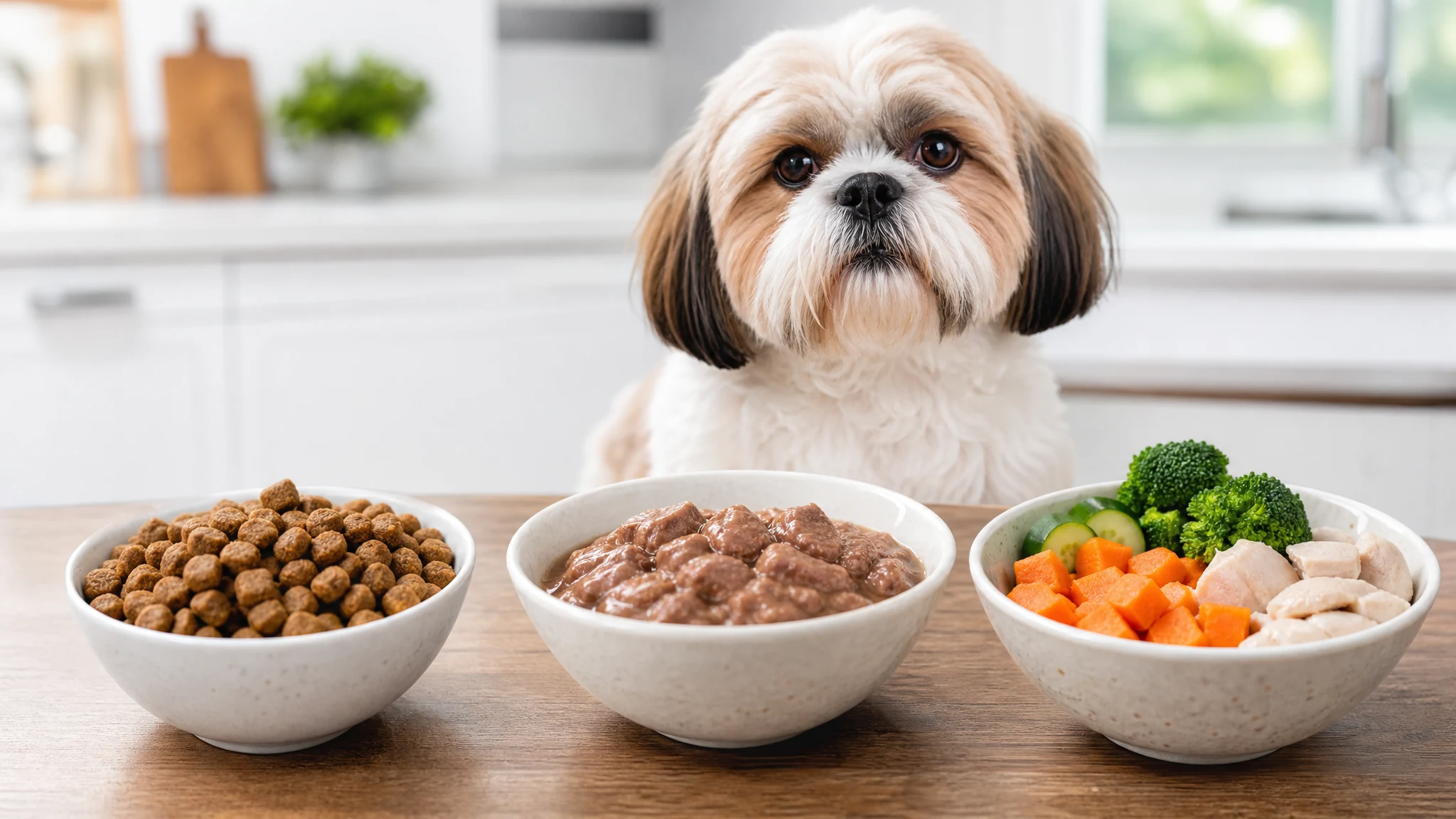
General nutrition information compiled from product labels and published sources, not veterinary advice. Your veterinarian is the right person to choose a diet for your dog, especially one with a health condition.
Most Shih Tzus weigh about 9 to 16 pounds as adults, according to WebMD. That is a small body with a small daily calorie budget, and the form of food changes how that budget feels in the bowl.
This page compares wet vs dry dog food and fresh dog food for Shih Tzus. It looks at moisture, calories per serving, daily cost in general terms, dental claims, mixing, and what is known about kibble size for a small, short-nosed mouth.
One note on method. We compared label data and brand product pages. We did not run feeding trials or taste tests, so nothing here says which food a given dog will like or do well on.
The short answer
No form is best for every Shih Tzu. Dry is the easiest to measure and store. Wet is useful for dogs that need more water in the diet or are picky about texture. Fresh is the most food-like but the hardest to store and portion.
For many households, the practical choice is a complete and balanced dry food, sometimes with a wet or fresh topper counted into the daily calories. Your veterinarian decides what suits your individual dog.
Side-by-side comparison
The figures below come from the brand pages for the products named. They are examples of each form, not a ranking.
| Attribute | Dry (kibble) | Wet (canned) | Fresh |
|---|---|---|---|
| Moisture | Low. Water is not a leading ingredient. | High. Water is the first listed ingredient on the canned examples below. | High. Whole foods such as chicken, liver and vegetables lead the ingredient lists. |
| Example calories | Royal Canin Shih Tzu Adult: 355 kcal per cup. Hill's Science Diet Adult Small Bites: 365 kcal per cup. VICTOR Hi-Pro Plus Small Breed Adult: 360 kcal per cup. | Royal Canin Mature 8+ Loaf in Sauce: 145 kcal per 153 g can. | Freshpet Small Dog Bite Size Chicken: 267 kcal per cup. Nom Nom Chicken Cuisine: 244 kcal per cup. |
| Storage | Shelf-stable. Easy to scoop or weigh. | Shelf-stable until opened. Leftovers need covering and refrigerating. | Brand pages describe fresh recipes that need cold storage. Check each brand for details. |
| Cost per day | Usually the lowest of the three, though it varies by brand. | Varies with can size and how much of the day's calories it supplies. | Often the highest, though it varies by brand and plan. |
| Portion control | Simple by cup or gram. | Simple by can, but a small dog may need part of a can. | Brand guides use cups or a calculator. |
| Texture for small mouths | Depends on kibble shape and size. | Soft. No chewing needed. | Bite-size pieces on some recipes. |
Moisture: what the label can and cannot tell you
Wet and fresh foods contain much more water than kibble. That is why the guaranteed analysis can look odd. The Royal Canin Mature 8+ canned loaf lists a 7.0 percent protein minimum, while the Royal Canin Shih Tzu Adult dry food lists 22.0 percent. The wet food is not weaker. It is mostly water.
The Freshpet small dog recipe lists a 16 percent protein minimum and the Nom Nom Chicken Cuisine lists 6.5 percent. You cannot compare those numbers across forms without adjusting for moisture. Compare within a form, or compare calories and ingredients instead.
The sources we relied on do not say that any one form is better for hydration in Shih Tzus. If your dog drinks poorly or has a health concern, ask your veterinarian.
Calories per serving: why small dogs need care
WebMD lists obesity among the health concerns it names for Shih Tzus. With a 9 to 16 pound dog, a few extra bites matter.
Dry foods in the examples above run about 355 to 365 kcal per cup. The two fresh foods run lower per cup, at 244 and 267. A cup of fresh food is therefore a smaller calorie serving than a cup of kibble, though a Shih Tzu often eats less than a cup either way.
The brand feeding guides show how different the starting points are:
- Royal Canin lists 3/4 cup (66 g) per day for an 8.8 pound, low-activity adult on its Shih Tzu Adult food.
- VICTOR lists 1/2 cup daily for a 5 pound dog and 1 cup for a 10 pound dog on its small breed adult food.
- Freshpet lists 1/2 to 1 cup per day for dogs of 5 to 10 pounds.
- Nom Nom lists 1 cup for a 10 pound adult.
Treat these as starting points. Hill's says to adjust amounts to maintain optimal weight and to ask your veterinarian if you are unsure. Watch your dog's body condition and adjust with your vet's guidance.
Cost per day, in general terms
The brand pages we reviewed do not state a daily cost, so we will not quote any prices. A fair way to compare is to work out how many calories your dog needs, then ask what each food costs to supply them.
Wet and fresh foods are commonly priced higher per calorie than dry, but this varies by brand and by how you buy. A Shih Tzu's small appetite narrows the gap, since a small dog eats little. Check current pricing on each brand's own site and do the arithmetic for your dog's portion.
Dental myths
A common claim is that dry food cleans teeth and wet food ruins them. The pages we relied on make no such claim for any of these products, and we found no source in our research that settles it for Shih Tzus.
Be skeptical of a bag that implies kibble replaces dental care. Teeth and gums are a veterinary question. Ask your veterinarian what dental care your dog needs, whatever form of food you choose.
Kibble size and the Shih Tzu mouth
Brand pages say a little about fit, but not in measurements:
- Royal Canin says its Shih Tzu Adult has a shape, size and texture designed for the breed. Its Shih Tzu Puppy kibble is described as adapted to the jaw of the Shih Tzu puppy. Neither page gives a size in millimeters.
- Hill's describes Adult Small Bites as a small bite size, again without a measurement.
- VICTOR describes its small breed adult as a nutrient-dense bite-sized kibble.
WebMD also lists short-nosed airway problems among Shih Tzu concerns, but none of these pages ties kibble shape to that condition. If your dog struggles to pick up or chew kibble, ask the brand for dimensions and ask your veterinarian. Wet food avoids the question, since it needs no chewing.
Pros and cons of each form
Dry food
- Pros: easy to measure, simple to store, and widely available in breed or small-breed formulas such as Royal Canin Shih Tzu Adult and Puppy.
- Cons: low moisture, and kibble size is often not stated in measurements. Calorie density is high, so overfeeding is easy with a small dog.
Wet food
- Pros: soft texture, high water content, and canned options exist for small breeds, such as Royal Canin Mature 8+ and Hill's Science Diet Puppy Small & Mini Beef & Barley.
- Cons: opened cans need refrigeration. Feeding it as the only food may cost more, and a can can be more than a small dog eats in a day.
If you are weighing wet food for Shih Tzus, check the can's calories first. The Hill's puppy can is 223 kcal for a 5.8 ounce can, which is a large share of a small dog's day.
Fresh food
- Pros: recognizable whole-food ingredient lists, high moisture, and small-dog recipes such as Freshpet Small Dog Bite Size Chicken.
- Cons: typically the highest cost, cold storage, and less forgiving of travel or a missed delivery.
One more point on fresh dog food for Shih Tzus. The Freshpet recipe is listed as grain-free. The FDA's page on canine dilated cardiomyopathy (DCM) was last updated on December 23, 2022. FDA said it does not plan further public updates without meaningful new scientific information, and it cautioned that adverse event counts alone do not show a product caused illness. We found no later update. Talk with your veterinarian about grain-free diets for your dog.
Mixing forms
Mixing is common. A spoonful of wet or fresh food over kibble can make a meal more appealing. The key is to count it. Subtract the topper's calories from the kibble portion instead of adding it on top.
Mixing also means mixing nutrition statements. Check that the main food is complete and balanced for your dog's life stage, and treat a topper as a small part of the day. If your dog has skin or ear trouble, which WebMD notes can have a food or environmental trigger, change one thing at a time and talk with your vet first.
Life stage and the AAFCO statement
Whole Dog Journal explains that foods for growth or all life stages carry one of two statements, either including or excepting growth of large-size dogs (70 pounds or more as an adult). Small-breed puppies can eat foods with either statement.
For a Shih Tzu puppy, that means a food excepting large-size growth, such as the Freshpet and VICTOR formulas, is not a problem on that point. Royal Canin Shih Tzu Puppy covers ages 8 weeks to 10 months, and its adult food starts at 10 months.
Also note how each claim is made. The Hill's adult and puppy foods cite animal feeding tests using AAFCO procedures. Royal Canin's pages say its foods are formulated to meet the AAFCO nutrient profiles. Both are valid routes, but they are different. See our label-data comparison of foods for Shih Tzus for more on reading these statements.
Best for: use cases
- Everyday feeding on a budget: dry. It is the simplest to portion and store.
- A picky eater or a dog that prefers soft food: wet or fresh, or a small wet topper on kibble.
- A senior Shih Tzu: a wet senior option such as Royal Canin Mature 8+ is made for small dogs over 8 years, but ask your vet what suits your dog.
- A dog watching its weight: whichever form you can measure most precisely. Dry and fresh both work if you follow a calorie target.
- Travel and busy weeks: dry.
- A puppy: a growth or all-life-stages food, with your veterinarian guiding portions.
Verdict
For most healthy adult Shih Tzus, a complete and balanced dry food is the practical default. It is easy to portion, which matters for a breed that WebMD says is prone to obesity.
Wet food earns its place for picky or older dogs, and as a counted topper. Fresh food is a reasonable choice if the budget and fridge space allow, but it is not proven better, and none of the pages we used claim it is.
No food prevents or treats a disease. If your dog has allergies, breathing trouble or a weight problem, your veterinarian is the one to choose the diet. Whatever you pick, read the AAFCO statement, check calories per serving, and watch your dog's body condition.
Sources
- WebMD: What to Know About Shih Tzus
- FDA Center for Veterinary Medicine: Investigation into potential link between certain diets and canine dilated cardiomyopathy
- Whole Dog Journal: In the Fine Print, Nutritional Adequacy Statements
- Royal Canin: Breed Health Nutrition Shih Tzu Adult
- Royal Canin: Mature 8+ Loaf in Sauce
- Hill's Pet: Science Diet Adult Small Bites
- Hill's Pet: Science Diet Puppy Small & Mini Beef & Barley
- VICTOR: Hi-Pro Plus Small Breed Adult
- Freshpet: Small Dog Bite Size Chicken Recipe
- Nom Nom: Chicken Cuisine